

Quantum Systems Australia Expands into Multi-Domain Uncrewed Capability

As modern battlefields rapidly evolve, the shift toward integrated, multi-domain uncrewed systems is no longer aspirational, it is an operational necessity. Quantum Systems Australia (QSA) is positioning itself at the forefront of this transformation, expanding beyond its established aerial intelligence systems into domains spanning air, land, sea, and counter-UAS.
At the centre of this evolution is a clear strategic intent: to move from being a platform provider to sovereign, multi-domain capability partner.
Managing Director of QSA, Michael Lillehagen, describes the transition as a natural progression of both technology and customer demand.

“We’re seeing a clear shift in how capability is conceived and deployed. It’s no longer about individual platforms, it’s about integrated systems that operate seamlessly across domains,” Lillehagen says.
QSA has built its reputation on uncrewed aerial systems (UAS), particularly in Intelligence, Surveillance and Reconnaissance (ISR), where modularity and operational flexibility have been key differentiators. The company’s aerial platforms, including the Vector AI which is capable of switching between fixed-wing and multicopter configurations with shared payloads, reflect a design philosophy centred on adaptability and mission efficiency.
That same philosophy is now being extended into uncrewed ground systems, with platforms such as the Mandrill unmanned ground vehicle (UGV), designed to support logistics, force protection and mission sustainment in complex environments.
“Our customers don’t operate in silos, and neither should their technology. The real advantage comes from connecting air and land systems through common architectures and software layers,” Lillehagen explains.
This integration is underpinned by a broader push toward sovereign capability in Australia. Quantum Systems Australia has continued to invest in local manufacturing, workforce development, and regional partnerships, aligning closely with government priorities around resilience and self-reliance.
While UAS remains a core pillar, the expansion into counter-UAS signals a recognition of the changing threat environment. Interceptor solutions such as Strila represent the next phase of capability, focused not just on sensing and awareness, but on active defence.
“The threat landscape is evolving quickly. Detecting is no longer enough, so there’s a growing requirement to respond, and to do so with precision and speed,” Lillehagen notes.
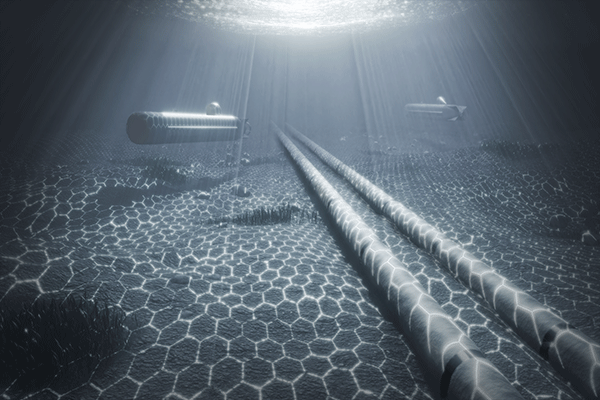
What distinguishes Quantum Systems’ approach is its emphasis on a “family of systems” rather than standalone products. By linking UAS, ground mobility, uncrewed underwater vehicles and counter-UAS effects through unified control systems, the company is working toward a model where a single operator can manage multiple assets across domains.
“Ultimately, this is about simplifying complexity for the end user. If we can give operators one system, one interface, and multiple effects, that’s where real operational advantage is created,” he says.
As defence forces increasingly prioritise interoperability and scalable autonomy, Quantum Systems Australia’s expansion into multi-domain uncrewed capability reflects a broader industry shift. The future is not defined by platforms alone, but by how effectively they are connected.
And in that future, integration is the capability.