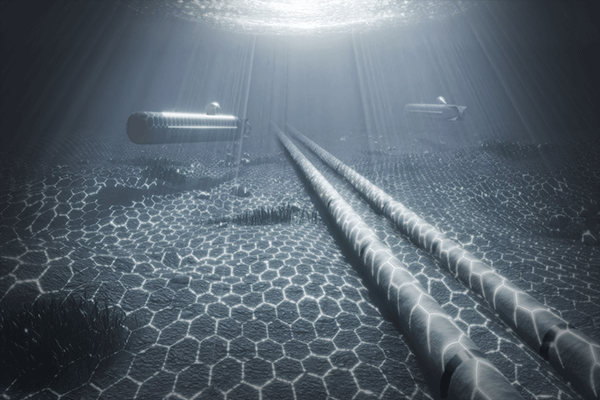


Two providers, one trench: problem.

The 2026 Integrated Investment Program put multi-orbit satellite communications in its top seven. What that buys at Tindal, Curtin and Learmonth is decided below the satellite.
The Commonwealth released the 2026 National Defence Strategy and Integrated Investment Program (IIP) on 16 April. One of the listed priorities is a resilient and secure multi-orbit satellite communications system.
Multi-orbit means using satellites at several altitudes, so an outage in one constellation does not take the service down. The IIP puts $5.2 to $7.2 billion behind satellite communications under SPA9102, and the request for tender is coming up in August.
However, the money for the systems on the ground moves the other way. The Australian Strategic Policy Institute notes the IIP’s share for enhanced and resilient northern bases falls from 4 per cent to 3.
Put another way, Air Force will operate more from the north but with less budget for hardening those bases. The Combat Support Group will have to close that gap through design, not budget.
A key design decision will be how to design communications links that are resilient to a provider going down or a cable being cut. This is trickier than it sounds.
“The second path is often the first path with a different invoice on it,” says Ryan Scott, Head of Defence at digital infrastructure provider Vocus. “Ask how many trenches, ground stations and carriers your traffic touches, not how many services you buy.”
Satellite carries the same trap. Two services can land at the same ground station, or hand to the same carrier once they are down.
Most commercial low Earth orbit (LEO) services also use public internet connectivity, which is an undesirable attack surface. “Layer 2” networking technology avoids that, allowing traffic to move between two points without touching the internet.
Vocus built Australia’s first Layer 2 integration with Starlink in June 2025, and lit Horizon, its 2,000 kilometre Perth to Port Hedland route, in June 2026. Horizon closes the western loop of a figure-of-eight national network, so if a core network cable is cut anywhere in the country, most data traffic can be rerouted the other way around the loop.
Past the fixed network sits the tactical edge, the forward-most point where people and sensors operate. “You rarely lose a link cleanly,” says Scott. “Decide in advance whether a sensor fails, buffers or degrades when its link drops, and who gets told.” He advises asking the following questions:
- How many providers sit behind each site, and how many physically separate paths? Two providers reselling one strand, or two fibres in the same trench is one path.
- Do your satellite services land at the same ground station, or share a carrier once they are down?
- If a sensor array loses its link, does it fail, buffer or degrade, and who finds out?
SPA9102 satellites will arrive long after the current posture is set. Nothing stops No. 1 Combat Communications Squadron tracing the paths behind one site this quarter, and finding how many are genuinely separate.