

What Does a C-UAS Training Mission Really Cost?
The purchase price of a drone is easy to compare. The cost of delivering a training mission is more complicated.
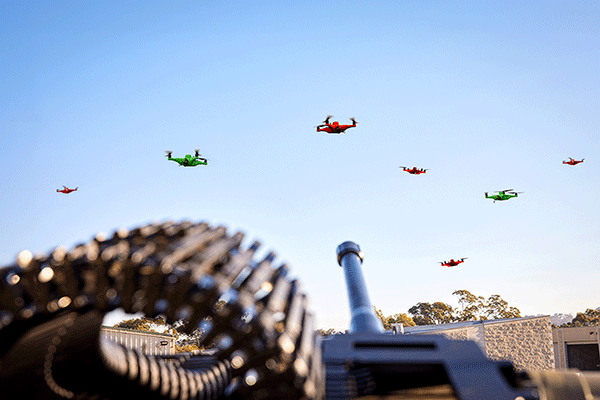
A manually flown FPV aircraft may be inexpensive, but the aircraft cannot present a threat on its own. Each drone needs a skilled pilot who has been trained, kept proficient, and made available for the event. A scenario involving several simultaneous targets generally calls for several pilots, along with the scheduling, support equipment, spares, and preparation for flight operation.
For a one-off exercise, that approach may be entirely appropriate. For a sustained C-UAS training program, repeated across crews, units, and locations, the economics look different. The relevant measure becomes the total cost of delivering each credible training mission, rather than the purchase price of each aircraft.
That calculation should include more than flight time. It should account for operator training and currency, mission planning, the availability of personnel on the day, recovery or replacement of aircraft, and the work required to prepare the next event. Those costs accumulate over a training calendar, even when the individual airframes are inexpensive.
Training objectives also shape the answer. Skilled FPV pilots are invaluable when a threat must react to the defenders, explore new tactics, or introduce uncertainty into a free-play exercise. They can help develop realistic profiles based on emerging threats. Their expertise should be used where it adds the most value.
Routine training and formal evaluation, however, often depend on consistency. If one crew encounters a different route, speed, altitude, or engagement geometry from the next, it becomes harder to compare results. When a system fails a test, evaluators may need to recreate the conditions to understand what happened. Repeatability is therefore more than a convenience; it supports meaningful training records, qualification, and evaluation.
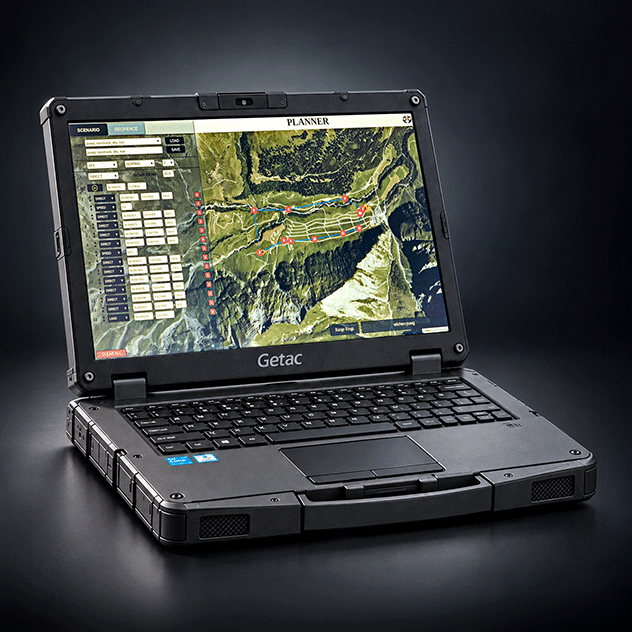
This is where the wider target ecosystem matters. Boresight’s Ground Control System (GCS) can execute planned threat profiles repeatedly, allowing trained target-system operators to deliver comparable scenarios without requiring a specialist FPV pilot to fly every mission. Its one-to-many (1:M) capability also enables one operator to manage multiple targets, subject to applicable authorisations and safety requirements. This approach eases the personnel and scheduling burden as training events grow in scale.
FPV pilots still have a place in that model. They can develop and validate demanding scenarios while the GCS reproduces them for routine training. The two capabilities serve different needs within a mature program.
Boresight combines target drones with integrated ground control operations to deliver credible, repeatable threat scenarios at scale. The aircraft are a vital component, but the system’s lasting value lies in enabling organisations to plan, manage, and reproduce missions reliably as training requirements evolve.
A lower-cost drone can be the right purchase for a particular task. For organisations responsible for sustained C-UAS readiness and regular training, the more useful question is what it takes – in people, equipment, and time – to deliver the next mission, and the one after that.