


On Drones: Tuning Tactics for Contemporary Tools
The Enduring Role of Infantry
The role of the Royal Australian Infantry is to seek out and close with the enemy, to kill or capture them, to seize and hold ground, and to repel attack, by day or night, regardless of season, weather, or terrain.
Since 1901, Australia’s dismounted infantrymen have shared much the same wartime job description, with only minor variations. As most civilians know, the following characteristics have applied for more than a century:
- Infantry walk around, carrying a rifle and other (heavy) equipment.
- Infantry operations are dangerous; our enemies have formidable long-range weapons.
- Military aircraft exist and threaten Infantry.
Our role is unchanged. Our tactics remain in a constant state of evolution.
Historically, Australian infantrymen are no strangers to aerial threats. Observation balloons, aeroplanes, helicopters, and drones have threatened infantry operations during a diverse array of wars across the world. Recent drone developments have seen old countermeasures revived and new ones pioneered.
Despite this, the pervasiveness and effectiveness of drones in contemporary conflicts has shocked many armies, including our own.
So what has changed?
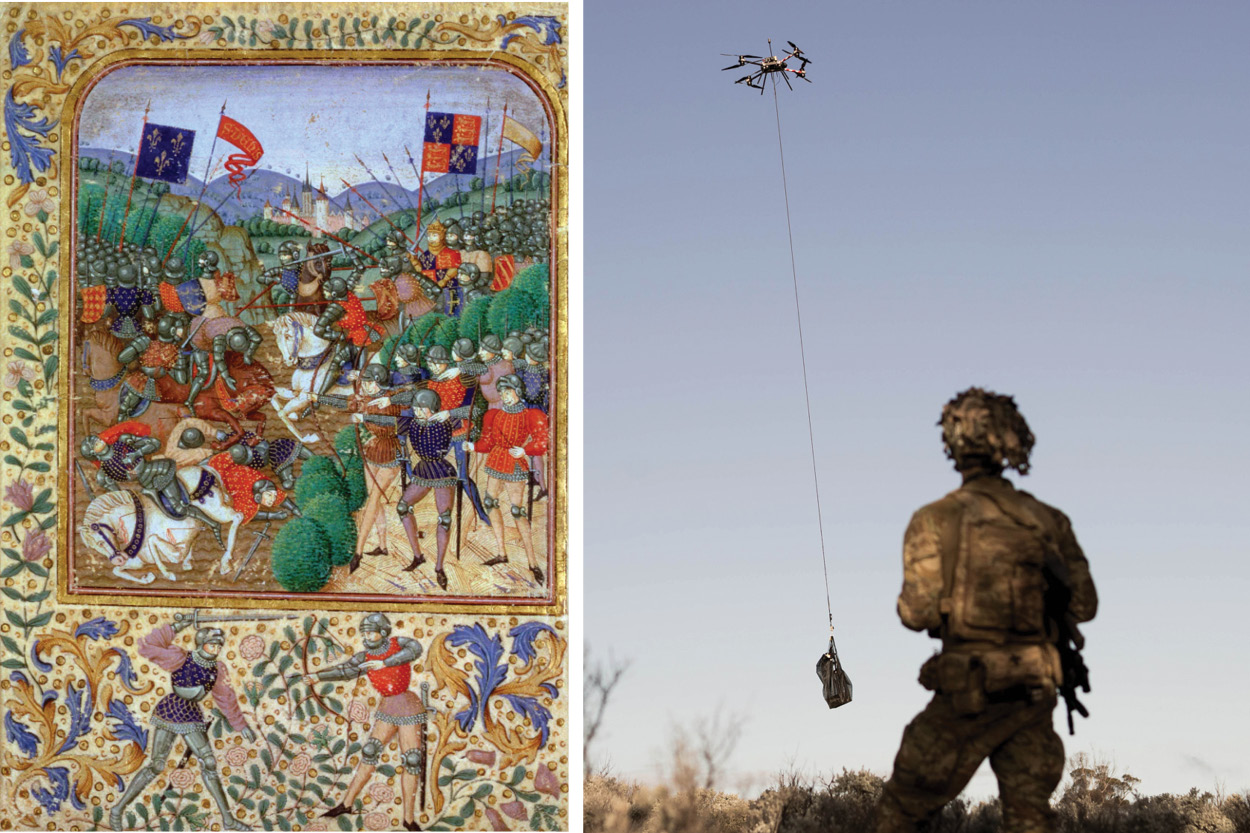
Across the world, armies are coming to terms with small attack drones. Professional combat officers lament the First Person View (FPV) attack drone just as knights lamented English longbowmen. Proud warriors in armour and helmets are, in 2026, flinging themselves away from their steeds because of a cheap and nasty ranged weapon. The 1415 slaughter of France’s finest knights did not trigger the English Army to trade in cavalry capability for more longbows, rather, revision of tactics enables mounted assaults to this day. Romantic notions and any twinge of dishonour we may feel should be overridden for the same reason cavalrymen eventually acquiesced to a battlefield dominated by machine guns.
The unrelenting threat of death—once reserved largely for the trench-bound infantryman—now affects all soldiers. Understandably, non-infantry spurn the austere wartime conditions of the infantryman, but emergent drone capabilities are dragging everyone else down to our repugnant level. Increasingly, there is no sanctuary in the rear echelon, no safety in numbers, and no platform immune to persistent surveillance and attack. The maligned “pogue” no longer enjoys luxuries unburdened by death’s spectre.
Send not to know for whom the bell tolls; it tolls for thee.
Enough poetry. What about the tactics?

Old Fundamentals, New Tools
Drones equipped with thermal cameras are remarkably effective and have enhanced patrolling speed and thoroughness, but the fundamentals of dismounted patrolling remain unchanged. Developing standard operating procedures certainly requires modification of established processes, but we make a concerted effort to avoid reinventing the wheel. Duplicating effort wastes the only resource that can never be resupplied: time.
Concealing vehicles, command posts, and defensive positions has become a pressing challenge for armies across the world. By comparison, RAS-enabled infantry patrols remain relatively difficult to detect, exceptionally lethal, and less tempting a target for an enemy who would often rather expend exquisite munitions against tanks, artillery, or command nodes.
Where previous generations would segregate roles, the RAS-enabled infantry platoon streamlines the process known as the kill chain. Surveillance sensors can rapidly cue reconnaissance drones to positively identify the location and disposition of valuable targets. Faster than ever before, the lowest tactical echelon can neutralise those targets.
Building Army’s Drone Combat System
Various exercises have demonstrated the effectiveness of this relatively new system. For the United States Army, Exercise COMBINED RESOLVE exposed significant vulnerabilities in conventional tactics. Less than 50 men, – a leadership team, four reconnaissance crews, two strike crews, an electronic warfare crew, and two bomber crews – a platoon-sized force effectively paralysed a U.S. Armoured Brigade, destroying more than 100 pieces of equipment in under 48 hours.
An essential step towards formalising and growing our nascent drone capability is qualification. Personnel from 5/7 RAR have trained on drone courses delivered by experts at the Land Combat College (LCC), who have pioneered a continuum of exportable courses. These courses produce qualified strike teams capable of tactically employing a range of offensive drones within the emerging Drone Combat System.
Army’s challenge is to swiftly test, acquire, and proliferate robotics and autonomous systems so that we can build an effective Drone Combat System across the force.
Battlegroup ANZAC and Experimentation
The 1st Armoured Regiment (1 AR) serves as Army’s combat experimentation unit and contends with that challenge daily. Alongside other units from the 1st Brigade, 5/7 RAR provided a contingent of officers and soldiers to 1 AR, forming Battlegroup ANZAC. This team’s purpose is to test and train with emerging RAS capabilities.
The value of this approach is simple: soldiers get hands-on experience with new technology and know firsthand what works well and what requires further development. Their reports are essential for decision-makers seeking to terminate inadequate projects or provide funding for the acquisition and proliferation of cutting-edge equipment across Army.
During May, BG ANZAC tested numerous drones: some optimised for reconnaissance, others for attack, and some capable of performing multiple roles. We tested platforms able to bomb foes and resupply friends. While it would be imprudent to discuss the exact capabilities of each system, Alpha Company soldiers have seen enough to appreciate their potential contribution to future operations.
Our reports will, funding permitting, contribute to Army’s acquisition of systems that could make Australian infantry extraordinarily potent against enemy High Pay-Off Targets.
BG ANZAC is currently deployed to the National Training Center at Fort Irwin, United States. Attached to the U.S. Army’s 4th Infantry Division, BG ANZAC is screening the advance of 3rd Armored Brigade Combat Team. Responding to lessons emerging from exercises such as COMBINED RESOLVE, American formations continue adapting their tactics to account for the growing effectiveness of drone-enabled forces.
We look forward to the abundance of lessons that will undoubtedly emerge from our deployment to the NTC.
During August, we will redeploy to the Townsville Field Training Area to oppose the 1st (Australian) Division on Exercise POZIÈRES RUN. This activity will provide one of the Australian Army’s first opportunities to observe drone tactics employed at scale. More importantly, it will allow us to apply and refine the lessons drawn from this year’s experimentation with the Drone Combat System.
The Tiger Battalion beyond 2027
When one considers our order of battle, the chart bears a striking resemblance to that of the Tiger Battalion of 1965, including its posted strength. While not quite a Pentropic battalion composed of regulars and national servicemen, today’s Tiger Battalion is home to more than 700 light infantrymen optimised for wartime service within Australia’s primary area of military interest.
Jungle warfare throughout the archipelagos to our north remains a daunting prospect. It is an environment that will almost certainly demand departures from many of the drone tactics currently being refined in the forests, fields, and urban sprawl of continental Europe.
Like our forebears, stealth, discipline, and aggressive patrolling remain essential fundamentals practised by our soldiers every day. Every available resource is directed towards degrading a vast, shrewd, and lethal adversary.
We are the privileged custodians of a proud tradition of jungle warfare, continually adapting to an evolving and capable threat within an increasingly complex strategic environment.
Like the Tiger Battalion that came before us, we are preparing for a future battlefield characterised by uncertainty and rapid technological change. Drones, robotics, and autonomous systems will undoubtedly shape how future battles are fought. Yet technology alone will never be decisive.
The fundamentals endure.
A soldier must still endure hardship. A patrol must still move unseen. Junior leaders must still make sound decisions under pressure. Infantry must still close with the enemy.
Our role remains unchanged.
Our responsibility is to master the technologies that will allow us to fulfil that role on tomorrow’s battlefield.
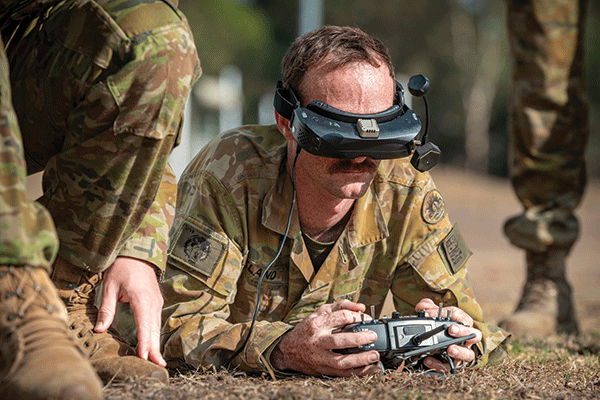
image Private Michael Blokland, Alpha Company, 5/7 RAR operates a drone using First Person View goggles during the Modify & Operate Attack Drone Course at Puckapunyal Military Area, Vic.
Main image left: Fought on 25 Oct 1415, the battle of Agincourt saw Henry V’s outnumbered English army destroy a French mounted assault. This victory inspired the Shakespearian phrase ‘Band of Brothers’. ight: A BG ANZAC soldier operates the Callisto 50 heavy-lift uncrewed aerial system carrying a load of ammunition, during a resupply drill, at Cultana Training Area during Exercise Black Prince III.


